

Deco Garden Design: Modern Gardens for Fresh Inspiration
Modern Deco style is about strong geometry and a clear focal point. Think symmetry, clean lines, and repeated forms that guide your eye like a good floor plan. Classic motifs still work, chevrons, zigzags, circles, and grid layouts, but in 2026 they look freshest when the palette is restrained and the materials do the talking.
Contrast is the secret sauce: light paving with dark joints, smooth porcelain next to rough gravel, glossy planters against matte stone. The garden feels “drawn,” not accidental.
Key Takeaways
- Start with simple geometry (rectangles, grids, straight paths) before choosing plants.
- Use a tight materials kit: one paving, one gravel, one edging, one metal finish.
- Create contrast with light and dark surfaces, plus matte vs glossy finishes.
- Pick one hero feature per zone (water bowl, sculpture, or statement planter).
- Repeat plant shapes in groups of 3 to 5 for a clean, modern rhythm.
Geometry first, plants second
Start by drawing rectangles and straight runs, then fill in planting like color blocks. Example 1: a straight path from the door to a single focal point (a bowl fountain or sculpture). Example 2: a simple grid of beds (four squares, split by two crossing paths).

Bold contrast without loud clutter
Pale paving + dark gravel reads sharp and calm. Glossy pots + matte stone adds depth. Choose one accent color (cobalt, rust, or chartreuse) and repeat it three times, don’t scatter it everywhere.
Hardscape ideas that instantly add Deco style
Hardscape is where Deco shows up fast. Keep the palette tight: one paving type, one edging, one gravel, and one metal finish.
- Large-format pavers (concrete, stone, or porcelain) for clean visual “panels”
- Metal edging to draw crisp lines around beds
- A border strip in a contrasting stone to hint at Deco pattern
- Black gravel or a dark reflective surface for drama
- One statement piece (a bowl fountain, screen, or sculptural planter)
Patios and paths with clean edges
Lay pavers in straight runs and align joints with doors or windows. Add one small nod to Deco: a stepped corner, a thin border band, or a semicircle cut-in at the patio edge.
Water, walls, and lighting as the “jewelry”
A slim rectangular pond or black reflective bowl gives that Art Deco mirror effect. Add a low feature wall with a built-in bench, then use linear lighting to wash steps and highlight texture. Keep electrics outdoor-rated and plan easy access for cleaning.

Planting for structure, shine, and year-round shape
Deco planting isn’t a cottage mix. It’s repeated blocks, like brushstrokes you can read from a distance. In 2026, a fun twist is one “special effect” plant used sparingly, like Petunia ‘Firefly’ in a single container for evening glow (as a novelty accent, not the whole scheme).
Go for strong silhouettes (then soften with grasses)
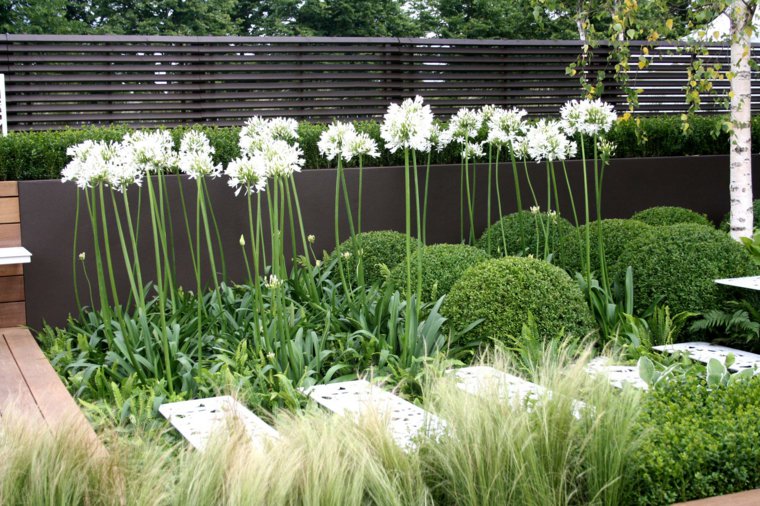
Yucca, agave, cordyline, and phormium bring upright shape. Add clipped shrubs for outline. Then soften the edges with ornamental grasses so the garden moves and doesn’t feel stiff.
Container planting that looks designed, not random
Pick 2 to 3 matching planters in different heights, plant the same species in each, and line them up in a clean row. Cube and tall-rectangle planters look especially Deco-friendly. For more bed-shape ideas, browse these easy flower bed designs for any garden.
3 simple layout templates you can copy this weekend
- Small backyard: rectangular patio, narrow reflecting strip, planter trio at the back fence
- Front yard or courtyard: bold straight path, one focal feature at the end, two mirrored beds
- Side yard: a linear “gallery” path, wall lighting, and repeated tall planters
Small backyard: patio, mirror water, and a planter trio
Build a rectangular patio by the door. Add a narrow reflecting pool, or swap in a dark gravel strip if you don’t want water. Finish with three matching planters across the back to frame the view.
Front yard or courtyard: a bold path to a single focal point
Use wide straight steps or a clean path to a sculpture or wall fountain at the end of the sightline. Keep beds symmetrical with clipped edging, then add low-energy LED lights for night drama.
Side yard: a linear lounge lane
Run stepping slabs in a straight line, place two benches facing each other, and repeat one architectural plant every few feet for rhythm.
Deco garden design is a modern garden style with Art Deco details. It uses crisp geometry, strong contrast, and one or two bold accents (like “jewelry”) to make a yard look intentional.
A deco garden design feels planned, not fussy. Start with shapes, then add texture and shine.

Layout and Lines
What to choose
- Rectangles, squares, and straight runs.
- A clear sightline from door to focal point.
- Symmetry or near-symmetry (especially in front yards and courtyards).
- Edging that holds lines (metal edging or stone borders).
Why it works
Strong geometry makes the garden feel “designed” from the start. Deco garden design depends on structure more than decoration.
How to apply it at home (fast planning flow)
- Sketch your space as simple rectangles.
- Mark one main walking line (door to seating, gate, or focal point).
- Split the space into 1 to 3 zones (path, patio, planting).
- Choose one focal point per zone.
- Add planting as blocks, not scattered singles.
Rule of thumb: If the layout looks messy on paper, it will look messier outside.
Materials and Finishes
What to choose
Keep the palette tight. Pick a calm base, then add one high-impact accent.
- Large-format pavers (concrete, stone, or porcelain) for clean “panels”
- Metal edging to draw crisp bed lines
- Gravel (pale or black) for contrast and negative space
- A small strip of contrasting stone as a pattern hint
- One statement element (water bowl, screen, sculptural planter)
Why it works
Deco gardens look modern when materials are repeated and controlled. Too many finishes break the clean effect.
How to apply it at home
- Choose one main paving type for all hard surfaces.
- Choose one edging finish and use it everywhere.
- Use tile or pattern only in a small, intentional spot.

Simple comparison table
| Material choice | Look | Upkeep | |
|---|---|---|---|
| Large concrete pavers | Clean, modern, quiet base | Low | |
| Porcelain pavers/tile | Sleek, polished, high-contrast | Low | |
| Gravel + metal edging | Sharp lines, graphic contrast | Medium (raking, weeding) | |
| Natural stone (dark) | Rich, weighty, classic-modern | Medium | |
| Black metal accents | Deco “jewelry” (screens, planters) | Low |
(For modern, minimal principles that pair well with deco garden design, see RHS: modern and minimal garden design.
Plant Choices
What to choose
Pick plants with clear silhouettes, then repeat them.
- Architectural plants: yucca, agave, cordyline, phormium
- Clipped shrubs for outline (choose a tidy evergreen that suits your climate)
- Ornamental grasses for soft movement and repeatable texture
If you want a single novelty accent, use it sparingly in one container. The goal is one small surprise, not a themed garden.
Why it works
Deco planting reads best from a distance. Repeated forms act like a pattern.
How to apply it at home
- Choose 3 main plant types for the whole space.
- Plant in blocks and clusters.
- Use the same plant in multiple areas to connect zones.
Rule of thumb: Repeat the same plant in groups of 3 to 5.
Color Palette
What to choose
- 2 to 4 main tones across paving, pots, and plants
- One light base (pale paving or light gravel)
- One dark anchor (black gravel, charcoal stone, dark metal)
- One accent color (cobalt, rust, or chartreuse), repeated on purpose
Why it works
A restrained palette makes contrast feel sharp, not loud. It also makes small yards look calmer.
How to apply it at home
- Repeat the accent color exactly three times (pots, cushion, one plant).
- Avoid mixing many pot colors and finishes.
- Choose either glossy accents or matte accents, then stick to it.
Rule of thumb: If you can’t name your palette in one sentence, it’s too broad.
Lighting

What to choose
- Warm, focused lights that highlight shapes
- Path lights to mark edges and steps
- Uplights to frame one feature plant or sculpture
- Linear lighting to wash a wall, step, or bench face
Why it works
Lighting is the “jewelry” at night. It should emphasize structure, not flood the whole garden.
How to apply it at home
- Light the focal point first.
- Add safety lighting second (paths, steps).
- Keep fixtures consistent in finish and style.
Rule of thumb: Light fewer things, but light them well.

Small-Space Ideas
What to choose
- One hero element that is easy to read (water bowl, sculpture, tall planter)
- Clean borders and negative space (gravel or open paving)
- Matching planters in a short row (2 to 3 pieces)
- One simple wall moment (screen, feature wall, or bench)
Why it works
Small gardens feel cluttered fast. Deco garden design stays modern by editing hard.
How to apply it at home
- Use larger items, not many small ones.
- Keep one clear path line.
- Leave breathing room around the focal point.
Rule of thumb: Pick one hero feature per garden zone.
3 Simple Layout Templates You Can Copy This Weekend
1) Small backyard: patio, mirror strip, planter trio
What to build
- Rectangular patio near the door
- Narrow reflecting strip (or dark gravel strip instead)
- Three matching planters along the back fence
Why it works It creates one strong view and repeats forms for a designed finish.
How to apply it
- Align patio joints with a door edge or window line.
- Place the water or gravel strip as a clean rectangle.
- Use the same plant in all three planters.
2) Front yard or courtyard: bold path to one focal point
What to build
- Straight path or wide steps
- One focal feature at the end (sculpture or wall fountain)
- Two mirrored beds on each side
Why it works The eye understands the layout instantly. Symmetry gives classic deco order.
How to apply it
- Keep bed shapes identical.
- Use clipped edging or a clean border.
- Add low-energy LED lighting for night focus.
3) Side yard: a linear “gallery” lane
What to build
- Stepping slabs in a straight line
- Two benches facing each other (or one slim bench)
- One architectural plant repeated every few feet
Why it works Long, narrow spaces improve when you treat them like a corridor.
How to apply it
- Keep planting narrow and repeated.
- Add wall lighting to make it feel intentional.
(For broader inspiration before you commit: Garden Design – Meet the new trends )

Mini-Examples (Concrete, Visual, Easy to Copy)
- Graphic path: Black steel-edged gravel with repeating clumping grasses. End with one matte black bowl planter.
- Simple patio focal point: A square patio with a dark water bowl centered. Add a low hedge in a neat square around it.
- High-contrast containers: Three matching tall planters in a row. Use one plant type in all three.
Frequently Asked Questions About Deco Garden Design and Modern Gardens
What is deco garden design?
Deco garden design is a modern style that uses Art Deco-inspired geometry and bold accents. It relies on clean lines, symmetry, strong contrast, and a small number of statement details.
What materials fit a modern deco garden?
Concrete pavers, porcelain, gravel, stone, and metal edging work well. Use one main surface and one accent finish to keep the look clean.
What plants look best in a deco-style modern garden?
Plants with clear silhouettes work best, such as yucca, agave, cordyline, phormium, clipped shrubs, and ornamental grasses. Repeating the same plant in groups creates a structured look.
How do you make a small modern garden look more high-end?
Simplify the layout, reduce material variety, and repeat forms. Add one focal element, then leave open space around it so it reads as intentional.
What lighting works for modern deco gardens?
Warm, focused lighting works best. Use path lights for edges and uplights to highlight one feature plant, wall, or sculpture instead of lighting everything evenly.

Conclusion
A modern deco garden design follows a simple formula: clear shapes, limited materials, structural plants, one focal point, then lighting. Upgrade in phases if needed. Start with edging, then paving, then plants.
What space are you working with right now, Eva, a front yard, courtyard, side yard, or backyard?






Related posts:
 Improve Your Garden With Round Shape Flower Beds: Fresh Inspiration and Design Ideas
  Garden design with stones and pebbles – 80 best ideas for inspiration
  36 Fresh ideas for a modern interior design
  30 Attractive low-maintenance garden and patio design ideas
  Gravel in landscape design: 42 ideas to boost your outdoor spaces
1 comment
[…] Image Source […]
Comments are closed.